I’m part of the lululemon collective and will receive a commission if you make a purchase through the links below
Hey!
Every week, I look around and see what type of gear I’m using or anything I’ve come across that’s cool and useful. Something that has made my life easier and solves a problem I’ve had for too long.
I’ll be keeping these fairly short with one tool/gear item that I’ve used and I’ll talk about how it’s useful (solving some problems).
There are many ways to use everyday items in a unique way. As an engineer and minimalist, I like to use what I have and see if I can make it work. It’s a fun little challenge that keeps my brain sharp.
Today’s tools are belts, created by Arcade and lululemon. We have two styles, two problems and infinitely great ways to use them.
The problems we solve:
So, I have a strap behind my legs that keeps my feet from sliding off the back of my footrest, but I spend my entire day pulling my feet back on the footplate after they’ve slid forward as a result of bumpy pavement or sidewalk cracks.
Pockets. Pant pockets are near impossible to use while you’re in your chair. I often go out for a walk and need to carry my keys, wallet, catheter and phone, but they’ll either fall out of my pocket or wont fit. Keeping them on my lap becomes a bit much and they easily bounce off.
Luckily, we have a solution for these problems, it’s more than a solution. It’ll tell the world that you mean something, that you’re on your way to success! (and you’ll feel as amazing as you look)
Contrary to popular belief, I’m a man who cares about style and presentation. Even if I do wear the same few clothes over and over again, I want them to be high quality clothes.
The solutions:
The Arcade belt.
It’s made for adventure, it’s durable, and it’s personal. There are many different styles for every mood and season.
This belt solves all of our problems. It’s easy to take on and off, it can even be useful when we’re not using it (like using it as a belt). It comes in many sexy designs, which means we look cool and get to show off a little. The size is adjustable so you can keep your legs where you want them. It’s a lot more versatile and when you watch the video below, you’ll see how it doesn’t actually wrap around where my other strap is. Best of all, the clip is super easy to put together and unbuckle. So, even if you struggle using your hands a little, it’s not hard at all!
Just when you thought it couldn’t get any better, imagine what you could do if the belt could also hold your keys!
Now we solve the second problem: Pockets.
You may have noticed that there’s a trend to wear a belt bag (fanny pack) across your chest. The timing has never been as perfect as now. Look trendy, be efficient, feel great!
This Fast and Free Run Belt is perfect for keeping your keys and a few essentials ready to grab and toss on before you head out (keys are small and valuable, they easily fall off my lap)
The On The Beat Belt Bag is big enough to hold more essentials (even a catheter or two) and even though the model is a woman, I would proudly wear this as a man.
Try this gear out and let me know how much it helps!
(Just some over delivery) This is my “efficiency outfit” I can wash less with the anti-stink tech, they dry fast (I avoid the cost of using a dryer), makes the perfect first impression and I feel like I can do anything (I can go to work and then workout without changing)
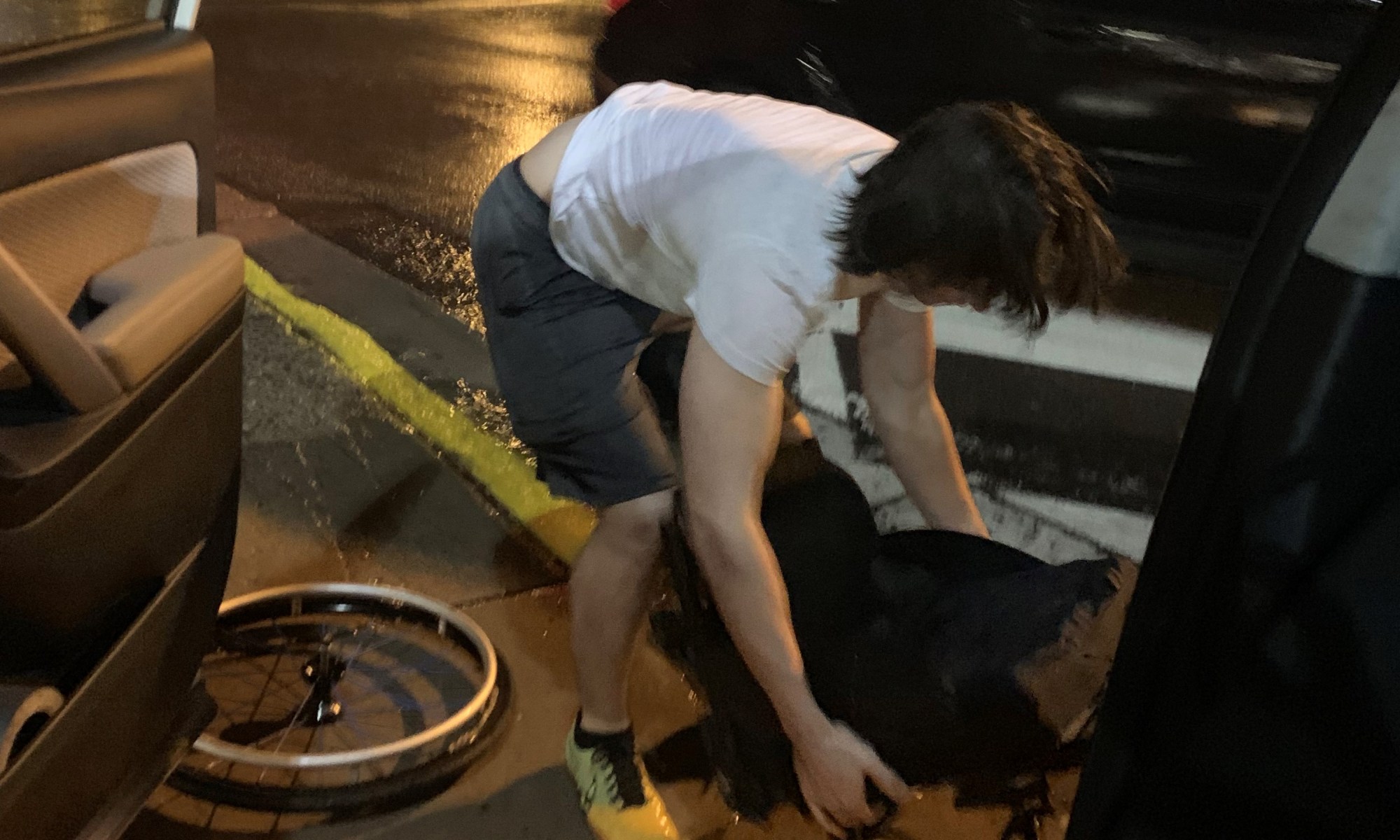
The featured image: It was raining hard after the gym, my friend went and pulled up my car for me and once I got in it, without me asking, he grabbed my chair and took it apart for me, getting soaked in the process.
The short answer is yesno. There is an argument for asking and not asking.
There is a viable reason you shouldn’t ask for help and there are a few fallacies for not asking. There is also a very good reason you should be asking for help.
Real quick, we’ll cover the reasons that are untrue so we can forget about those and make room for the rest.
The myths about not asking for help
If you’re worried about interrupting, so you don’t ask for help, then you’re being silly. I was having tea with a friend of mine at a cafe, we were just having a good talk about our lives and work when a loud tapping noise came from the glass door. I finally knew what it was like for animals when a little kid, ignoring the rules, taps on the glass.
This interruption wasn’t from a little kid though, and I wasn’t annoyed, though our conversation was interrupted. There was an elderly woman at the door and she had to use a walker (to walk), so, she wasn’t able to pull the door open. So, my friend got up, she went to the door, opened it and had a little small talk with the woman and then we resumed.
If that elderly woman cared about interrupting, she wouldn’t be able to enjoy her medium roast, let alone anything beyond a door that doesn’t slide open automatically.
For the most part, we wrongly assume the reactions of our actions. I did NOT think, “that woman is rude and interrupted my awesome conversation, she shouldn’t have done that.” What I did think was, “that right there is a strong woman and I’m happy that she is able to set aside her worries about what others think so that she can get the help she needs.” The only other option would be for the woman to wait at the door until someone snapped out of their caffeine daze and asked her if she needs help getting in. Don’t wait for others to offer help, they’re always willing to help, and you’re more than a good enough reason to interrupt. Remember that.
Invalid reason two: worried about being a burden. There comes a point in every paraplegics life, hell, this applies to everyone, we go through the “nuisance barnacle” phase. A term that I just came up with while writing this. This is where we feel like our relationships are more parasitic than mutually symbiotic. We feel like a burden. We feel that we ask too much of people and are no more than a barnacle. A nuisance to be dealt with.
It’s a good thing babies aren’t philosophical because they’d be all over this one. But no one hates babies, they’re cute, even when they throw up on you.
There are times that we need a lot of help. We feel as though we could never repay that favor someone just did, or we just feel like we require too much help. It weighs on our conscious and we feel as though we’ve lost our last shred of independence. There are times that people will get annoyed with you. That, more likely than not, is a sign that they are perceiving you as needing too much and not trying.
I’d always end up broken down on the highway. When I stood there trying to flag someone down, nobody stopped. But when I pushed my own car, other drivers would get out and push with me. If you want help, help yourself – people like to see that.
Chris Rock, Net Worth $100 Million
Everyone is familiar with a variation of the quote that says people will help you if you help yourself. We’ll definitely be talking about that a lot.
If someone is getting annoyed with all the help you need, there are three main reasons for this. The first two, you have some control over and I give you the possible solutions for all three.
From their view, you seem to be asking and not trying yourself. I like to try to get up a set of stairs on my own before I ask for help. That way the person can see that I’m trying and putting in the effort instead of making them my beast of burden. If I fail, I will need help, though.
This could also happen if the help is controversial. Maybe they think that you’re more than capable of doing what you’re asking. Don’t be lazy. Don’t get used to having too much help, otherwise, you’ll start asking for help with things you don’t need help with and that will make you weaker. Think of what happens if you wear a neck brace longer than you need to. You take it off and have a floppy neck. Don’t have a floppy neck.
They might not have signed up for this. Maybe they just didn’t know how much the word “help” indicated when you asked if they could help you or when they asked if you needed help. The way I solve this is by letting them know what help entails when I ask. I’ll say what type of help I need and then ask if they mind doing it. If it’s small, like grabbing something off a shelf, then it’ll typically be catered to. If you ask a random person on the street to help you and they blindly follow you to 20 stairs, they probably didn’t expect such a strenuous task, on top of that, they might not be confident in their ability to help.
The one that’s out of your control is their attitude. If someone just got into a fight with their significant other, or maybe their baby threw-up on them for the fifth time that day, then you’re out of luck. It is possible that asking them for help will help them feel better because helping heals the soul. It is equally possible that some people are rude, maybe not on purpose and sometimes entirely on purpose. Maybe someone in a wheelchair had wronged them and now their perception of the entire community is corrupt.
This is all to say: there are good reasons to not ask for help. The two reasons I explained above, being a burden and interrupting, are not good reasons to avoid asking for help.
What is the reason you should not ask for help?
The only good reason you should not ask for help is something I hinted at above. The floppy neck.
You will get used to asking for help, I sure have, but luckily I catch myself or I’m in good company and they know to say no.
If you surround yourself with people who really love you and want to see you grow, people who know what you can and can’t do (and want to see you increase your “can do” list), then you’ll be on your way to Mach 1 success.
Again, this is where the MVP tough love comes in and makes the winning shot. If you surround yourself with people who really love you and want to see you grow, people who know what you can and can’t do (and want to see you increase your “can do” list), then you’ll be on your way to Mach 1.
As I said, you will probably get to a point where you ask for help too much.
There is something I still do, which isn’t totally bad. Whenever I’m in a store and I don’t know where the item is that I need, I’ll ask someone where it is without even looking and it’ll often be within sight. I could claim that I’m not wearing my glasses, but that’s a cheap excuse. Personally, I would rather ask right away and get the answer than waste time looking.
The problem here is that you don’t learn much when the answer is handed to you. You learn much more when you discover something yourself. How will you find out how you can best go up a set of stairs if you’ve never really tried on your own? You need to avoid asking for help when it comes to certain things, what those things are is up to you and your good judgment, which I trust you have since you’re here.
Of course, there is a threshold for what I’m saying, there is a point where you can be stiff-necked. The polar opposite of floppy neck.
With floppy neck, you lose your strength. With stiff neck, you lose your flexibility, that is to say, being stubborn is only good to a certain point.
People around you WILL get annoyed if you insist on doing something independently for too long. In the same way that I reached floppy neck, I’ve also been stiff-necked, so I know what it looks like – ugly.
The point for not asking is so that you learn how you can do more and get the experience needed for more independence. I don’t ask for help before I try something myself. Even in a store, I’ll sometimes grab a box of pasta to help me reach something on the top shelf before I ask for help.
I’ve always been one to try before asking for help, that way, I’m knowledgeable about what can be done, I can tell the person what I did and maybe they can suggest a different way, or at the least avoid repeating what I did. Especially for being in a wheelchair, if you don’t try something yourself, you won’t be able to tell the helper which ways work best. Meaning, you won’t know what you need help with and where you struggle.
If you’re going up a set of stairs for the very first time and you ask for help right away, you’re assuming that the helper knows how to help someone in a wheelchair get up stairs (and that the person they helped before was very similar to your abilities). This is a terrible situation to put the helper in, you just made them responsible for your inevitable failure to ascend stairs (if you’re in rehab, it’s a bit different). You need to try it yourself, then, you’ll know what parts you start to really struggle at and where the helper can best apply themselves. The goal over time is to need less and less help. If the helper is someone you’re familiar with, you can experiment with them and ask them to help a little (or a lot) less each time and if you still fail, they can adjust accordingly and go back to the full heap of help.
What is the reason you should ask for help?
We covered it a little bit, but now I’m going to expand on it. If you’ve watched TV at any point in your life (I haven’t watched TV in years, but I still know this), you’ll be familiar with a scene that unfolds like this:
Dude A is trying to do a comical task that is way above his skill level, Dude B can definitely do it and insists on helping because he recognizes that Dude A will fail.
Dude A has too much confidence and wants to do it himself, Dude B relents.
Dude A tries and fails. Dude B tries to come back in before the situation gets worse.
Dude A still wants to do it himself and pushes Dude B away.
Dude A continues, and in the final act, he ends up hurting himself and those around him. FIN
Dude, that’s not cool.
Dude A gives it a shot, he really tries to do it himself and wants to accomplish this task all on his own. I can respect that, but once Dude A fails, he needs to recognize that he is going to hurt himself, hurt those around him, or at the very least, annoy and inconvenience everyone (beyond the acceptable limits).
Remember how we mentioned the phrase, people help those who help themselves. I did NOT say, people try to help those who help themselves but their help is denied because the person helping them-self is focused on them-self and not getting the job done. Big difference dude.
I avoid saying that I have regrets. But before we’re done, I have a story about a regrettable time, but I don’t actually regret it because it taught me a valuable lesson about being too stubborn and not asking for help.
On Easter day, about 3 months after I left rehab, I had just gotten back from church and we were going in for a lovely Easter brunch. I was a lot different even a year ago, I was a lot more stubborn. I really wanted to master stairs, I had already gotten good with stairs in rehab and I continued to work on them thereafter, but I wasn’t able to do all stairs.
The house didn’t have a ground entrance, it had a wooden porch with steps that led up to it. I really wanted to get up there on my own. I wanted to be able to say, “Head inside and I’ll be there in a minute.” Just as casually as someone who might split off from a group to make a phone call to their family but catches up in a few minutes, I wanted everyone to head inside and not even think twice about my ability to “catch up” in a few minutes.
I tried doggedly because after all, tenacity runs in the MTU blood. My efforts were to no avail and I couldn’t even get past the second step. Everyone just wanted to go inside and eat and spend time together. I tried, I failed, I was nearly in tears. There is a time and place for not giving up, but this was not that. On my own time, sure, I can go back and try until my arms fall off. But when people are waiting on me to just let them help me, AFTER I already gave it my Easter best, that’s when it’s time to hang up the boots and just get my ass inside and enjoy the company.
This whole post is an important one for people in wheelchairs to have in their mindset toolbox, it also applies to anyone who tries anything. If you ever see someone who is a victim of the fallacies we covered, asking too much or not asking enough, kindly share this with them and make the world a little bit better.
Immediately actionable items: Do some introspection and see where some of this applies to your life. Then, take the next opportunity you have to try something new, make sure its something that you’re sure to fail at and then ask for help after you’ve tried.
Summary: Talking about when you should and shouldn’t ask for help. There are some misconceptions about why you shouldn’t ask, but there is also a feasible reason to not ask for help. There is also a very good reason you need to ask for help.
Overdeliver: Another reason that it’s good to ask for help is that people like to help. Think back on a time that you helped someone. You felt really good about it. When someone asks to help you, unless you really want to do it yourself, take them up on it and it’ll make your life a little easier and it’ll make them feel good. Don’t deny someone the feeling of goodness if you can give it to them.
Let’s make this quick. I should be studying right now but I became so enticed with the idea of sharing this that I couldn’t resist. I also used a very grainy picture and I’m not ashamed.
The list is simple. You have 2 sections. One for what you will do in a wheelchair and one for what you will do when you are out of a wheelchair.
PS, if you’re not in a wheelchair, this applies to any dichotomy in your life. Maybe you have a broke leg or something that has a before (right now) and after (in the future). It can also apply to being in quarantine.
Why do you need to make this list?
There are many psychological reasons to do this type of thinking. We’ll talk about the benefits of this list along with some explanation of what this list really is.
This list is ever-growing. I call it the Dual Dreams. But don’t let the word “dream” confuse you, these are actual goals that we will actually achieve. Convince yourself of that right now. Before you even know what this list really is, it’s important that you let the benefits of psychology take over and truly believe that this list is not some cozening list full of pretentious, drivel hopes that we retreat to in tough times so that we can take our minds to a mythy world. This is about real life, not mystical fiction.
You can also call it the “twain aims” list if you’re feeling fancy and the rhythm is within you.
Here are the two main benefits that I get from having this list, and there are probably a lot more.
I would even recommend printing this list and posting it up on your wall next to your bed or somewhere in sight.
The first benefit is that it will give you hope. When things seem down, maybe you’ll never walk again, take a good look at this list, visualize yourself doing these things and remind yourself that it is your goal and your mission to walk once more. Don’t allow this list to dispirit you, instead, have it imbue you with excitement for the future and remind you that you CAN and WILL do these things. Even if everyone is against you, you will prove them wrong!
The second benefit is that it makes you seriously consider and challenge what you can do NOW. Never get caught up in the pernicious feeling that life is over and you can’t do anything anymore. Maybe you won’t be able to achieve the “Things I’ll Do When I Walk” list right away, but that’s why we have the other section. You are forcing yourself to challenge what you can do while in a wheelchair.
This list excites me beyond exposition. It reminds us that we can still achieve a lot while we’re in a wheelchair and that life is pliable, we shape it with our actions and mind. If you perceive your life as over, everything will soon reflect your philosophy.
How do you actually construct this list? What does it look like?
I recommend making the list of things you’ll do when you walk, or gain some degree of ideal mobility back, first. Make this list ample. Be creative and think big. What else will you do? Think small?
After you make this list reflecting your wildest dreams, explicate and challenge each item, give serious thought to whether or not this is something that can only be done after you’ve recovered.
Sometimes, I’ll think of something new that I really want to do and write it down in the “recovered” section but then realize that I can totally do it this week if there weren’t issues with money or some learning curve. So, I take the ambition and move it to the other side.
[Aside] This list actually started off as just a list for what I’ll do after I walk until I realized how powerful it will be if I add the “while injured” section.
This is a real list, some of the things on this list will be humdrum, but they are nonetheless important to us. You may not think that playing volleyball is all that grandiose, but for me, it’s something I really enjoy. I’ve never shared or told anyone about this list and now I’m going to reveal it to the world. Remember that this is MY list, based on what I like and how I want to live my life, we will have big and small things, so long as they are important to us, and we intend to complete them as if it’s life’s dictum.
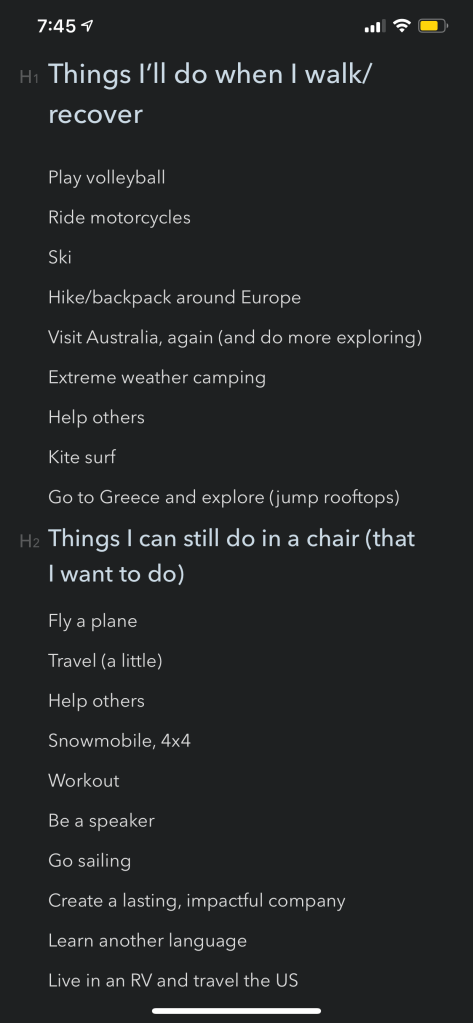
Here’s what MY list looks like. There are some things that we could belabor on whether or not they should be on the “Walk” side of the list, but we won’t.
Remember that the things on the list are for you! (I’m saying it a lot because it’s important)
For me, I know I could ski while still in a wheelchair, and I might. But when I say ski, I envision the type that isn’t in a wheelchair/adaptive skis, and that’s the type of skiing that I want to do. I also want to live in an RV and drive around. That one was in the “recover” section until I realized that what I envisioned could easily be done in a wheelchair and it wouldn’t impact the reason I’m doing it (explore, travel, learn and have fun). I could technically travel to Greece in a wheelchair, but I wouldn’t be able to do the things I want to do (lots of stairs in Greece). I think you get the point.
The Twain Aims List, AKA Dual Dreams
By the way, this list is in an iPhone-only app called “Bear”
Immediate action item: Make this list right now!
Summary: Create a list with two sections: Recovered and Injured, then write what you’ll do for each part of your life. This is a must have list for anyone in a wheelchair. If you’re not, then I still recommend making the list based on whatever dichotomy is present in your life. It’s helped me a lot!
Overdeliver: Even though I’ve kept this list private, until now, I have gotten involved in the communities for most of these topics and then I inform people of my ambitions (naturally, in conversation) and they are always wanting to help. Take flying for example. I went to EAA Oshkosh and now I know many pilots or retired pilots who want to help me and see me succeed. I’m very grateful for all of them and the only thing really holding me back is the money and the ability to prioritize the apposite time commitment to flying. Remember that everything you’re doing and not doing (within your physical limitations, but even that’s debatable) is a representation of how you prioritize.
PS: PS can be Post-Scriptum or Pre-Scriptum, language is malleable
When you first see your doctor or nurse after getting paralyzed, your mind is flooding with questions and thoughts.
We’re going to start with a quote to set the mood.
It is not the answer that enlightens, but the question.
Eugene Ionesco, French-Romanian Playwright
By the way, if you look closely at the featured picture for this post, you’ll see that my doctor and I are matching with turtle necks (also socks but that’s cropped out)
I asked him a lot of questions.
There are a lot of questions you should be asking yourself and the people around you. In this post, we’ll focus on the first few days after your injury and some key questions to ask the nurses or doctors.
Keep in mind that these are not all the questions, but they are questions that I’m glad I asked and some are ones that I really wish I asked.
NOTE: I’m going to say doctor for simplicity of writing, but you could think of it as meaning doctors, nurses, therapists or anyone in the medical profession.
A lot of people will ask “Will I walk again?” and the doctors will avoid a definite answer. They truly don’t know. Sometimes it may seem like you will walk, but your injury might be just enough so that you don’t. Everyone truly is different in regards to their body, injury and how it recovers.
Asking if you have a chance to walk again is not going to get you anywhere, doctors don’t want to give you false hope and then become your outlet for hate. They didn’t do anything other than give you an answer to your question.
Remember that doctors know a lot, you have access to years of experience, research, and schooling. Think of all that they do know. They might not know the future, but here are a few good questions that could give you better answers.
Questions for your journey to recovery
What can I do to improve the odds of walking again?
Do you know about any resources I can look into? (books, articles, etc.)
Are you familiar with any medical devices that might help me recover?
Do you know anyone else who is? (always get more than one opinion)
Are you aware of any herbal medicines that could help or resources where I can learn more?
These questions go a lot deeper than the yes/no “will I ever walk?”
Now that you’re in the world of SCI, it’s important to know more than the average bear.
Make sure you know about your injury. Look at the x-rays, ask the doctors to tell you what you should be looking at. You could even have them draw on the paper copies and annotate them.
Questions about your injury
What was the procedure of my surgery? (a summary of what they did)
What is my injury level?
Typically, what does an injury of that level entail?
From the surgery, what tools were put in? (I have metal rods in my back)
Is there anything I should watch out for, concerning the tools?
Is my spinal cord bruised or severed?
How does the spinal cord heal?
Where on the spinal cord is the damage?
Does this area typically relate to a certain function?
What type of injury is this? (this is meant to be for the vertebrae and spinal cord, it could be a fracture or a burst or something else and the spinal cord might be severed or bruised)
Asking questions like these is only good if you remember the answers.
Personally, I like to take notes in notebooks.
These are some great notebooks for you to document your journey and thoughts:
Another important topic to cover in the early days is considering your health.
Now that you understand the fundamentals of your injury, how the spinal cord works and the options you have that pave the road to recovery, you need to learn about the effects.
What types of changes can you expect in your body? What are the potentially bad things that could happen and how can you reduce the chance of it happening?
It’s important to start considering your health immediately. Your body is going to change in dramatic ways.
This doesn’t mean life is over, it only means that your priorities are going to change. Team Cosmo is known for being able to adapt to new situations and flourish!
Questions about your health and body
Assuming that I don’t gain any more movement than I have right now, what types of changes are likely to happen to my body?
When will I know that my body is near finished healing? (Since my spinal cord was bruised, I asked this and was told that the majority of my healing will happen within 5 months)
What are some changes I should be aware of that might affect me the most?
What can I do to improve my health and make sure that my body is in its best possible condition? (diet and exercise/stretching)
What are some things that might arise? (give an example like muscle spasms or nerve pain)
For that/those issues, how can I best deal with them? (diet, medication, best practices)
Remember that these questions are not all that you can ask. I see these as the bare minimum. There is never a bad time to ask your doctor these questions if you don’t know the answers yet, but I recommend that these types of questions are asked as soon as possible after an injury.
I plan on writing more posts that cover questions to ask in rehab and anywhere else that might help.
Remember to share this post, you never know who could benefit from this. Helping heals the soul.
Immediate actionable items: Write these questions down and brainstorm more of your own. Comment down below some good questions/answers you’ve come across. Most importantly, ask these questions and document the answers. Don’t rely on your memory, this is important information.
Summary: Asking the right questions is important. Here are three categories of questions designed for the early days after your injury. Questions about recovery, injury, and health & body.
Overdeliver: Whenever your doctor does something, either prescribes medication or advise you on something. Remember to ask why, but asking “why” can sometimes come off as if you’re rejecting their expertise and it puts them on the defense, try to phrase the question similar to these, “I’m curious, what’s the reason for that?”, “What is the benefit of ____?”, “Can you explain that?” , “I’m not sure I understand. What is this for?”
At the beginning of my journey, I was in the hospital (of course), and I was extremely uncomfortable with everything. The thought of a catheter makes anyone squirm, even at this point, over a year after using catheters every day, I try not to think about it.
I’m not as manly as you might think. For the 6 days, I was in the hospital after my surgery, I hated when I had to “cath.” I would take a pillow and put it over my face and tell the nurse to just tell me when it was over. Even though I couldn’t really feel it, I was afraid that I might.
Just a few days before, I was walking and NOT using a catheter, I didn’t even know what a catheter was.
I took it to an extreme. By the third or fourth day, I was down from four IV’s to just one. I didn’t need much of any medication. However, I was so terrified of being able to feel the catheter that I still took pain killers. I demanded it. I didn’t need them at all, though.
That’s how scared I was about feeling the catheter.
Right now, I’d go back in time and slap myself.
Don’t make the same mistake. For using a catheter or anything, really.
When I went to rehab a few days later, I knew something had to change. I realized that I can’t be scared about cathing if I expect to recover and gain my independence back.
The very first day, the nurse who came in, his name was Caesar (his name is Caesar), I told him that I need to cath (it was a long ride from the hospital to rehab) and that he needs to teach me how to do it.
Two mistakes I made in the hospital:
I didn’t take responsibility for myself and I avoided doing what was necessary
I didn’t learn how to be responsible for myself
Some of you might not physically be able to cath, that’s totally fine.
The point here is that you have to do everything you’re capable of doing.
In the hospital, I could have asked the nurses and doctors about how catheters work, best practices, and how to do it.
Visualize what life will be like once you’ve recovered. For me, it involves living a life of freedom – traveling and exploring. I might buy an RV and live a life of touring the country. If that happens, and I hope it does, I will probably have to poop in the woods at some point.
When I was scared of cathing, did I expect someone else to do it for me my whole life, when I absolutely can do it for myself? Honestly, I can’t understand why I was even okay with someone else doing that for me.
It gets a little worse.
A catheter is only for #1. What about #2?
This next part is 18+
Don’t continue reading unless you’re prepared to feel uncomfortable.
If you’re not 18, but in a wheelchair, then you’ll probably be familiar with this, so for anyone in a wheelchair, this is another day in the park. (Not that it’s nearly as pleasant).
For me, and it may differ drastically for everyone, this is called the bowel program. I came up with many names, such as “poopy program” or anything that didn’t sound so medically uptight. After all, I already had a finger up my ass.
It took me much, much longer to accept that I had to “manipulate my bowels.” I don’t remember when I first did it myself, but if you’re patient and a fast reader, I probably mentioned it in one of my Instagram posts.
This is one of those things that I look back and shake my head a little. I don’t remember if I ever pooped in the hospital, but before I tell you about my first time doing this myself, here’s how it worked in rehab when I didn’t do it for myself.
At a set time every night (rehab was very regimented), I would grab my fancy hospital bed remote and press the button I was all too familiar with. The SOS. The help button.
The nurse assigned my room would come in. We always bantered and had good conversations. They would grab the incontinence pad unless I already had one under me. It’s pretty much a square diaper. I would take off my diaper. By now, the door was shut and my Mom had left the room, thank God.
The first step for the nurse was to put on some medical gloves, then some medical lubricate on their finger and while I lay on my left side, go in and clear out the colon. Then, with the “ready to go” stuff out, we wrapped it up in the incontinence pad and like planned magic, there was another pad underneath. Part two is that a laxative was put in and the nurse left, waiting for me to call 15 minutes later to take the second incontinence pad, wrap it up and we’re done.
The song I played.
Nurses were both men and women. One time, I played this song as one nurse came in. Luckily, she thought it was funny. Even when a nurse is coming in to put their finger in your butt and pull out poop, you can still be lighthearted.
This went on for a lot longer than it should’ve. If you’re reading this while you’re in rehab or even still in the hospital, then I’m happy.
I want this message to get to as many people as it can early on.
This was something that I just couldn’t accept doing for a long time. It was outside of my comfort zone. This was astronomically out of my comfort zone. I didn’t expect it to be done for me forever and again, I was completely able to do it for myself. Because of that, I can’t imagine why I was so much more comfortable with someone else doing this.
The first time I did my own bowel program
I had prepared. The past three or four nights, I wasn’t just lying on my side in silence. I was asking for gruesome details. I knew that I needed to do this on my own. In rehab, they also have standards they hold you to. They expect you to progress and have thresholds for how long you can be in one spot. I had reached the limit for how long I could avoid doing this.
It was the nurse that I carelessly whispered who came into my room and told me to get up and do it myself. Instead of doing my bowel program on the bed, which would’ve been a lot harder, she had me get into my wheelchair, go into the bathroom and transfer onto the toilet commode (a cushioned chair with a hole in the middle). At this point, she was giving me the tough love that I am more than thankful for. I live for tough love. She wouldn’t believe me that this was actually my first time and that I still didn’t know what I was doing.
I double gloved. I wanted to put as much distance between me and this process. Two gloves was the best I could do. After that, I put on the lubricant and manipulated my bowels.
A quick note: while I was doing this, the nurse told me that sometimes this will cause people to pee and that sometimes people peed on her! It takes a brave person. She was still helping me and making sure to coach me through this unthinkable process, so, she was sitting right in front of me. You can use your arm to point “it” down while you do this (doesn’t apply to women).
Ever since that day, I’ve been doing the bowel program myself. I only wish that I had done it myself a lot earlier than I did.
Immediately actionable item: Ask yourself, am I avoiding doing something that I shouldn’t be? Set a plan to do it today, or begin the process today.
Summary: Don’t hesitate cathing or your bowel program. Do as much as you can early on. You’ll have to do it on your own at some point. I waited way too long to do some things on my own. It takes a lot of courage, but it’s something you need to do.
Over-deliver: A lot of people won’t give you the tough love you need. They’ll give you the easy way out and help you if you ask. If things seem too easy, ask for tough love.
This is my first “blog.” I wanted to at least have one or two for you when you got here.
I’m hoping to have at least one blog post per week. They may be short, like a little paragraph weekly challenge or long enough to split into two separate posts. I’m focusing on two things, equally ranked: give value, have fun. I enjoy giving value, so, having fun while doing it should be easy 😉
Also,
I’m extremely excited! Not only am I able to reach and help more people, but I’ll improve my writing skills, and I really enjoy writing.
Even though I don’t have much in terms of blog posts, all the pages on this site have a lot of new info on them, stuff I haven’t talked about on Instagram or YouTube. I think the Cosmo page has the most on it. I had fun writing that one.
As I’m writing this, I just finished recording about 20 minutes of video content for Instagram.
I’m in Australia and I did a campus tour & talk. All about my time hear up to this point. More or less rambled about my time here, and ranted and raved about the nature on the the campus. It’s probably a little cringey but I was just free flowing, having fun recording some videos.
I’m also putting this blog in every category that I’ve made so you ‘ll have an idea of what kind of topics we’ll cover together. More will be added over time.
For now, check out my Instagram and YouTube after you’ve gone through all the pages on this amazing website!
There are a couple forms you could fill out on the FAQ page and the Keynote page
Remember to share this website, you never know who it could help.
Much love to Team Cosmo
Stay healthy!
-Cosmo
PS, I’m writing this post while outside doing a time lapse of the sunset for my Instagram video and I got bit TWICE on my pinky by mosquitoes. That’s the type of devotion I have to Team Cosmo





 Wheelchair DNA
You must be logged in to post a comment.