Back when I first started reading, like really really reading and getting into the whole personal development world, I read something about “become deserving of the life you want.” At this time in my life, I thought this could be extrapolated out to just about anything. The idea being that you prepare yourself and when the opportunity arises, you’ll be ready for it and seize the moment. Similar blurbs are things about greatness favors the prepared.
The biggest mistake I’ve made was extrapolating this theory out to what type of relationship I wanted, as in, I would imagine my ideal woman and then think about what type of man I should be to “deserve” her. For about a year, this was my north star – I’m ashamed that I let this happen – I was fully motivated to become someone for someone else who didn’t even exist. How shallow. Well, to be fair it’s not all that bad since my ideal woman could be said to be a reflection of my ideal self. But you get the point, I should be thinking first about my ideal self.
How I came to realize the errors of my ways was when I watched the movie The Secret Life of Walter Mitty after it was recommended by a few of my friends. I thought the premise was greatly inspiring – a boring office-bound man breaks out and explores the world on an adventure. Then I thought more about the premise – a man likes a woman, fantasizes about being interesting to her, and then begins to take risks/adventure with her in mind (they didn’t get together until the end of it all and she hardly knew him until the end). Sorry for the spoilers. This general premise is prevalent in a lot of movies. If you don’t pay attention, you will passively accept this. I think it’s one of the worst ideas to be so subtly imbued. The idea of the one-sided pursuit, being motivated by someone who may not know you exist, putting in effort before you even truly know someone all for the chance of a fade-to-black happily ever after.
As a caveat: putting in effort to build a relationship is necessary, no doubt about it. But that effort should be mutually founded after both people agree to build the relationship together.
If you’re going to break out of your comfort zone, do it for yourself. Do what you’re interested in, do what excites you. Don’t think about some real or imaginary person and have your life decisions, energy, and money, all based on impressing them. I’ve heard so many stories of people learning a language or a skill just to get closer to someone else without knowing if that person is interested in them before embarking. Then, when it doesn’t work out, they complain as if they deserved the person. That they were entitled. You’ll see in movies the man works hard to get the woman to fall in love, or he likes her a lot and feels a sense of entitlement to her reciprocation, if only he worked hard enough or became the man she deserves. This is also the whole premise of The Phantom of the Opera, by the way (sorry, spoilers). In the end, the lesson learned is that you should be true to yourself and your interests because we live with ourselves everyday. If you like someone, you should not change to become more to their liking, and especially not before they even know you and have expressed interest.
If you consider anything from a perspective of a time distance enough for it to not have any meaning, well then it won’t have any meaning. It’s a trueism often spoken in other ways such as “nothing matters anyway, we’re all gonna die” and the like. What I never hear anyone talk about is the opposite – instead of going further and further out into time until we reach the heat death of the universe, starting from there and coming closer and closer to the present moment until there is a difference / meaning.
Almost everything is forgotten or disappears over time. After a few generations, you will be an ancestor whose genetics and traits are all but gone along with any memory of you. With this perspective, it feels like there’s no point in trying hard or anything. It’s almost a feeling of hopelessness or whatever German word exists for realizing how little control & effect we have over most of our life and environment. It feels like the world wouldn’t really be different without me.
All this is a matter of perspective. The above is the wrong perspective. It’s just so easy to believe that the world will continue on and be unaffected by our living or dying that we don’t stop to question why it’s worth thinking this way. Not debating how true it is and with what caveats, but rather why do we let this be our default perspective? The right perspective is that everything does matter. Because we exist now and there is nothing more worth considering. If I can make someone happy now, help someone now, be valuable now, well, this is the only time it matters. How long lasting are the effects of when I went to Africa for a mission trip? Did I impact all those kids in a positive way that will ripple through time? Maybe or maybe not. But that’s not what’s important. What I would rather focus on is that in those very moments of helping is where the impact was. It’s not my concern if they remember me today or tell their kids about me in 10 years. In the moments I had to help, I did and it was significant.
For climate change and other things like that, it’s very important to consider our actions in this moment as they relate to the future. But other than that, my argument is that it’s pointless and maybe even harmful to thing too far out into the future. We will all be forgotten and lost in time. But that never was and never will be the point. The point of it all is what we do now. Not to be remembered, but to be.
PS instead of thinking whether or not something will “matter” in 10 years, ask if it will matter tomorrow, in the next hour, in the next month.
This is something that has been a lingering and slow developing thought that I finally had some conclusive internal dialog about.
I am often told how inspiration I am. Thank you. I guess I am. I won’t try to argue against it. But I don’t feel that way. I’m just doing what I do. I don’t see how it’s inspirational. I feel like just a normal guy who does things. This amount of humbleness is probably making you throw up in your mouth. Nonetheless, it’s true. Maybe because I’ve never really felt inspired by anyone. I’ve had admiration and respect for many people, but I don’t think I can honestly say I’ve been inspired. It’s possible that I’m forgetting something or that I have been inspired but haven’t labeled the feeling as such. Whatever. The point is that when people see me do pull-ups, travel, have a positive attitude, and otherwise go about life as if nothing is wrong, I suspect that what they call inspirational is actually a feeling of “if I were him, there’s no way I could or would be doing all that.” No one knows what they’re capable of until they are faced with a challenge. A lot of people don’t do half the things I’ve done in a wheelchair in twice or five times the years. So, I suppose some people really couldn’t do what I do if they were in my situation. That doesn’t mean it’s all that special.
There is a difference between hard and harder.
That’s the main idea that has been lingering in my thinking brain and what I’m writing about now. Yes, going to the gym is harder is some objective & quantifiable ways. Getting in and out of the car is hard amongst other things I can’t think of. Once I’m in the gym, I do what I can and I struggle the same as everyone else. We move heavy weight and try to do more tomorrow. We build ourselves slowly, with dedication and consistency. I am no different or any more special than whoever is with me in the gym 5 days a week ad infinitum. Just because my life is harder, doesn’t mean it’s actually harder in the way you might think.
Everything is harder. Nearly everything I do is objectively harder in that it takes more effort, more time, more ATP energy, or psychologically. But this does not mean that everything I do is actually hard as in difficult. Harder does not mean hard.
When I was at a bodybuilding show, signing in and getting my number, I talked to a few people backstage and one of the conversations I was part of was between me, a retired wheelchair bodybuilder and a magazine photographer. The photographer mentioned how much respect they have for the wheelchair bodybuilders and made reference to the other guy competing at the Olympia a few years back. I kept my mouth shut but here’s the truth. It is no special. I might be the only honest person to say this. Wheelchair bodybuilding is not special. Forget the wheelchair. I didn’t have to overcome anything other than the same exact suffering that any good bodybuilder endures. Bodybuilding is essentially this: super human discipline, scientific starvation, weightlifting. Drugs too but they don’t actually make any of that easier. There is no reason that I can see why I should get more praise than the next guy over. We literally do the same thing, I just skip leg day. I feel the same way about losing weight. I’ve now come to learn that 99% is just being in a calorie deficit. Exercise helps with muscle mass and looking good, but it has nearly no effect on actual weight loss. It’s all about a healthy calorie deficit. I once saw someone in a wheelchair talk about their weight loss journey. That’s good for them, but being in a wheelchair does not make it impressive or inspirational. Being overweight and being in a wheelchair (via a spinal cord injury or whatever) are two totally separate things.
I guess I went off the rails there for a little bit. The point is that harder does not mean that it’s actually become hard. Not everything instantaneously becomes some monumental Atlas or Herculean task. Getting in my car is not hard. It’s just harder than what normal people do. I won’t lecture or scold anyone for complimenting me on doing it. I did once see someone who was resenting, complaining, and lashing out against those who complimented them for doing simple daily tasks such as getting into a car. I saw this as a social media post. I hated it. Let people be impressed. Say thank you and give yourself a pat on the back because it actually is impressive. Just because something gets worse, doesn’t mean it’s now bad. If you get a rock in your shoe during a beautiful hike, does that ruin the view?
Edit: Here’s an example that I think really gets the point across. I was just talking with my brother about this. How do I articulate to you that just because the way I do things is harder, it’s not actually hard.
Here’s the example. When I get into the car (like I’ve been mentioning), I have to transfer into the car and then take my wheelchair apart. This makes getting into the car take more time and effort than for a normal person. BUT, if my brother gets in the wheelchair, lifts himself into the car, and does everything I do for taking the wheelchair apart and lifting it into the car, he would say “oh, that wasn’t that hard.”
I have an added process for getting into the car, which makes it harder. That extra process, however, is not difficult in and of itself.
Something that stuck with me from one of my university courses about electronics – you can have high speed, small size, and a good price. Choose two. It’s pretty true. If you want a compact computing chip that’s wicked fast, it will be very expensive. The formula here is two characteristics that make the third go up if combined. You want an affordable toilet, good looking toilet, and one that’s made of good material. Choose two.
So, this applies to life on a broader scale. And none of this is much of a revelation as much as just articulating a truth so understood on a subconscious level that we neglect to give it any attention. I think because doing so doesn’t really change much or help us in any way. Trade offs. We always must make concessions, ideally these are based on our values but more often our emotions (is there a difference?).
Here’s what this article (blog if you must and I wish you didn’t) is about. Life in a wheelchair. Where to live, what makes it good, and what are the trade offs?
I’m going to break it down into every single aspect that matters. First on why, then what the trade offs are (if any) and maybe some other things. Categorizing all this is tough, like a Venn diagram but much more complicated. I think comparisons and consequences may be the way forward. Also it would make a good title (adding it now).
What I care about: Good weather, public transit, accessible infrastructure (sidewalks, entrances, transit, housing), healthcare, culture, public goods, and geography.
Weather
As a wheelchair user, the weather will affect what you do and what you can do. I used to live somewhere that had a lot of snow and long winters. I would get stuck in the parking lot on my way to my car and then struggle to wipe off 400 cm of snow. In cold, snowy weather, my legs and feet will get dangerously cold with their lack of blood flow. If you have a car, then you go from building to car and car to building through the snow. Not much else. Even getting around my university campus not more than 20 meters was a very very hard and discouraging thing to do. I would only go out if it was really worth it.
If you live without a car and there’s snow, then you’re on the sidewalks until you get to a train or bus station. This sounds much worse. I can’t imagine trying to carry groceries home in a situation like this, especially if the terrain has hills, getting stuck going up or losing control down a hill I can only think of as a nightmare.
Weather is one of the most important factors for life and lifestyle in a wheelchair. Being anywhere that has a major snowy season should be avoided at all costs. Anywhere that has no winter/snow or very small amounts of snow makes a massive difference. I’ve done both. When the weather is good, I go out more and I’m much happier. In the snowy winters, I’m much more isolated. Other than snow, the next thing is rain, but this is much more manageable.
Public Transit
There is a fair case against public transit. You are beholden to the timetables, delays, cancellations, and destinations of a system you have no control over. Any commute has the possibility (keep in mind the probability could be low) of contagious/dirty people, crying babies, and breakdowns. In New York City (Manhattan Island), only certain stations of the train are accessible (have an elevator), I got off at an accessible station and the elevator was broken. I then had to get back on and go to the next accessible station and possibly transfer to another train to get closer back to where I originally wanted to go. It was also very dirty, some people were rude, and some areas were very confusing to enter/exit.
When it comes to public transit, it’s good if it’s good. When the stations are clean, the bathrooms are clean (and free), the transit is fast, having an elevator is the rule instead of the exception, there are busses and trains to get you almost anywhere, and the elevators are well maintained. This is Japan and Singapore (other places too, but I haven’t been to other places yet).
When you use public transit, you eliminate the enormous headache that a car brings. Paying for insurance, getting hand controls, getting in and out of the car, constant maintenance, the higher probability of an accident, and being alone so much.
I think public transit for people that use wheelchairs is a game changer. But only if the weather is good. Entirely relying on transit means that you also need to go to the station, doing this through the snow will likely result in more “snow time” than going from a building to a car.
Accessible Infrastructure & Geography
A city means nothing if you can’t get into any restaurants, stores, homes, or even just to go around the city. When I was in Germany, I could get into a lot of places but quite a few multiple steps up or down. There were a lot of cobblestone areas, too. In Seattle, the whole city is on a hill that feels like it’s going up every way and when it does go down, it’s so steep you burn your hands trying to slow down. It’s impossible to avoid hills. It’s impossible to find a city where a wheelchair can get into every building independently or with very minimal help. Even downtown in the city of Boulder Colorado (very, very liberal if you don’t know), there are a few places with a stair set going down as the only entrance.
What I’m looking for here is that I can get into most places. That my friends don’t always need to visit me. I can go walk around the city alone without needing help up a hill or up a step to get into a building. Here’s the trade off on this. If you rely on public transit and walkability, it’s inevitable to have more issues than you would in a car. It’s because the car is replacing the walkability. You go from parking lot to parking lot in a car and you go to a place where you can just get right in. When you’re walking around a city, you absolutely will find a sidewalk that ends at a curb with no ramp/gradient down to the street. Or small cluttered sidewalks that force you to go in the street. You may come across a restaurant with high barstool seating and nothing else.
We know that nothing is perfect, but we can score the cities. We need good sidewalks. I once asked some people about my possibly visiting Thailand. They said the sidewalks are so bad they won’t even try to go out with a pram (stroller). We need most buildings to have a ramp or elevator. Modern housing/apartment buildings so that there are more options when it comes to where to live – even if it’s not marketed as “accessible,” if there is ample space and an elevator, that fulfills my needs. The older the housing infrastructure means smaller and no elevator, or they have it at such a premium to render it prohibitive.
In a few words – mostly flat, mostly modern. In every aspect. The transit, housing, buildings, and land (for being flat).
Public Goods
Mainly this is about bathrooms. In Europe it’s very uncommon to find a public bathroom, or you have to pay at a train station. In the USA, there’s usually a bathroom everywhere you go, but again, the USA is a place where you drive from parking lot to parking lot. You are almost never “in between” as you may be in a walkable city – where you find yourself needing a bathroom halfway through a 30 minute walk with only small shops around.
In places like Japan and Singapore (again, these are the places I’ve been, so not an exhaustive list), the bathrooms are plentiful. They’re free, accessible, and very clean. I have pooped and peed my pants in many cities across Europe. Never once in Japan or Singapore.
There are other public goods to talk about, such as parks or whatever. I’m not concerned about these. What I really care about for a city, a walkable city, is that when I’m walking around (and it’s the only way to get around), I don’t have an issue when I need to pee.
Healthcare
Skipping over the truth, it’s easy to say that in the USA, you can’t get healthcare unless you have a job. You can. It’s hard. It’s not that good. It’s common to say that in Europe, the healthcare is better. I don’t know a lot about the details. Here’s what I can say confidently: for a wheelchair user, having medical needs (catheter, etc.) is almost a known/given. Personally, this is kind of low on my list. If I’m in a city that has good public transit, public goods, and it modern in it’s economy and infrastructure, then I’m sure there’s a way to get healthcare. Whether or not it’s affordable or how easy it is to get, I’ll find out. I know that it won’t financially kill me. It can’t.
The Life We Choose
These are all the major attributes of a city to consider. They are objective. The only other aspects are language, culture, and personal values. If you love everything about Copenhagen, then maybe you can handle a snowy season or have a winter home in Barcelona if you’re bank account is well endowed. There is no perfect city, and why should there be? Life is all about trade offs. When we decide to do something, anything, we intrinsically are deciding to not do many other things. If we want public transit, then we will sometimes miss the train. If we want a car, then we will sometimes have a breakdown with no friends to come help fix the car. Choose the most important, and leave the rest. I would love to live in a small apartment where there’s a social culture in a walkable city than be rich and alone in a big fancy house. There are downsides everywhere. Corruption. Oppression. Cultural incompatibility. No place is perfect. Don’t look at it too long. Don’t look at it from too far away. Don’t think yet about the destination. Look at the journey. Get close, inspect at each hour of the day, understand the routines of each week. Are you fulfilled? Most of us will do the same thing anywhere – eat breakfast, go to work, do a sport, cook, clean, sleep, shop, and so on. That’s the journey. And now forget the journey. It’s never really been about the journey or destination. It doesn’t always matter where you are or where you’re going. It’s about the company – who you’re with. The memories made along the journey & who’s there with you at that destination.
The End
I often wonder if a majority of people in wheelchairs find themselves all gravitating to the same city but each person comes to the idea independently. I think Singapore is the best city for me. Because of the reasons above but also because I only speak English and I love the culture (this last one is very subjective). Anyway, I hope you can come to understand that if you choose to live somewhere with lots of snow, maybe it’s because you’ve built up a community of friends and family to help you with the snow. Having that can make any amount of snow tolerable. If you are more alone or independent, choose no snow but maybe you have to make concessions on the quality of public transit? It’s up to you.
There’s no point in keeping something for later use, especially if it’s a one-off. When I went to Japan, I brought back some sakura mochi. It was a good and unique treat, so I wanted to “save” them. Eventually, they went bad. I only ate about half. From this, my biggest lesson learned – use things as soon as possible. There’s no point in having anything unless it’s getting used in some way. An expensive painting kept under your bed or in a closet for no one to see but for it to be kept safe because of how nice it is misses the point. The value is in it’s use, which may lead to it’s demise but all the better. I’m not saying to be careless and disrespectful, also, sure, some things should be made to last after our death. Then again, if you can’t enjoy it to it’s fullest purpose, why have it? If you say it’s an investment, will you ever realize the gains?
Especially now, in the age of over abundance, keeping a nice shirt nice at the expense of doing what you want is only harm to you. Don’t wear a nice shirt to go hunting in the mud, that’s just stupid. But if you’re at a wedding and you won’t dance or have fun so the shirt would get ruined, that’s when it’s an issue. This assumes you’re not so totally broke that you have one nice shirt and can’t afford another without the rent being paid.
Buy nice things and use them. Otherwise we or the things expire. My rule is that when I go through all my stuff under my bed or my closet, I ask myself if I’ve used it in the past year. If not, how can I start using it now? Sometimes there’s nothing I can do with it, so I throw it away or donate it. It’s been out of sight and of no use for so long.
There are some keepsakes that have their place under my bed, such as all the letters/cards I got when I was injured. I keep these and similar good-memory type items because I have space under my bed for them and it doesn’t actually hurt me to keep them. Though, as soon as I move and need to start compromising what to bring and what to leave, anything non-functional is left behind.
My advice: buy that expensive whiskey, bring home whacky foods from traveling, get that high quality jewelry, bring a beautiful new painting into your home, but don’t ever “save” it for a special occasion. Don’t deny yourself a pleasure for that “special moment.” Wear the jewelry daily until it breaks, invite friends for no reason other than to try that food or drink. Let the painting get sun bleached because it looks nice in your room when the sunlight hits it just right. Break things. Wear them down. Die with nothing unused.
Before I went to the gym, I decided to write for the first time in a long time once I got home. I haven’t written in a really long time, hardly read anything either – if this ends up so dry that it’s easier to eat than read, I hope you came hungry.
I have nothing specific to talk about, but that’s never stopped either of us, so I might as well start with this. I currently am hit with a wave of sadness about just being alive. Using my best analysis, it’s probably because I just got back from the gym – a haven that I’ve come to loathe. Not because of what it is, but what it once was and every rep and workout reminds me that all my friends are not here. There’s a last time for everything and that’s easy to understand but it’s hard feel after realizing the last time (or best times) has come and gone.
With this in mind, I should stop writing immediately to avoid the hazard of making everyone think I’m on the brink. But I’m afraid I won’t ever come back to this draft. Happy thoughts. It’s hard to do. This past year I’ve had to face the music about the stem cell treatment not working. It’s not all too hard when I have a beautiful girlfriend, travel, have my family around, support from friends, a good job that gives me financial freedom and a lot more vacation than most people my age. Well, what I should really say is that it’s not hard to face the music if I have other things – good things – in my life to distract me. But there are those moments, even while traveling, where I zone out and get deeply, momentarily, depressed and I honestly don’t think I’ll make it past 30 – I don’t want to – is this really me now? Then I snap out of it and the thought doesn’t come back for months. The good thing is that I know thyself & this is an emotional reaction, very much in the moment. Almost childish, like how a kid will scream and kick until a few seconds later forget it all and go run around with his friends like nothing happened. For me, this happens when I’m blatantly confronted with a terrible truth about life in a wheelchair. Unfortunately, this happens most when I am outside of the safe zone – i.e. when I’m traveling. There is no solution, maybe just mindfulness and acceptance but I’m no shrink.
So there, we went in a downward spiral. I guess the only place to turn is philosophy since I don’t really have good news to announce except that I’ll be slowly putting more effort into my “brand” WheelchairDNA – YouTube, writing and so on (no AI, pure human words here). I’ve been thinking lately about the regression to the mean. Usually spoken about in the context of the stock market. Essentially, there is no endless growth. (I don’t actually know this, and I won’t fact check myself, but this is how I understand it) You take the % gained / years invested and given a long enough time, the % gain will match the mean (average) of the market. In another way, given a long enough time, anything exceptional will become average. You can be great one year and even grow to be greater, but exponential growth can’t be sustained and over time that greatness just won’t be special.
I think about a time in middle school, I took an aptitude test that, among many things, asked me to memorize a sequence of numbers and repeat them back. I was told that my score was at the 16th grade level. That’s college. I also could be remembering wrong but that’s the difference between a memoir and a biography. After that test, I went back to class and nothing changed. Now I’m beyond university, and might even score worse if I took the same test. I remember when I was about 7 or 8 months after my injury. Working at Kimberly-Clark for my internship. I was in the gym, I had traveled to Europe (1 month after leaving rehab, 2 months after injury), I had a car, and I was way ahead of the game. A guy in a wheelchair asked me “How many years have you been in a wheelchair?” “None”. Only a couple months, and I was proud of that. I had excelled in rehab and went far beyond that. Exponential growth. But there’s a ceiling. For example, I mastered doing a wheelie, going down stairs, how to effectively lift weights, and maneuver international travel. Once I did all that, no matter how impressively early, it eventually becomes normal. I no longer can say I’ve been in a wheelchair for a short time and done so much. I’ve been in a wheelchair for some years now, all those things are nearly expected, kind of normal. Still impressive, but at this point you won’t be shocked. It’s the itch for new that’s been well scratched. Even think about weightlifting, there’s a video online when I was 14 or 15, before my injury of course, deadlifting 4 plates – 405lbs (~180kgs). That’s insane. But, overtime, I regressed to the mean. The interesting, or potentially interesting, thing I thought of is that perhaps the regression to the mean only applies if you continue investing. If you buy a stock and never buy anything else, perhaps it never regresses. If you do something great, then die, no one sees that greatness dissipate. All that’s left is what could have happened. This is why people like JFK, Caesar or Lincoln are so popular. Not that they were so perfect, but we only remember them at their greatest, they never had the time to regress to the mean. History had a chance to see Napoleon rise and fall, maybe it’s just that he overreached, but imagine if he were assassinated at his height of military power and French territorial control. Even if it didn’t last without him, we would all speculate on what more he could’ve done.
One of my favorite speeches I visit often is David Foster Wallace’s commencement speech – This is Water. Like a listening to a sad song when you’re sad, there’s a word yet to exist that describes the comfort in hearing someone else verbalize exactly how you feel – sometimes better than you ever could. I’ll learn German first then get back to you on what to call that feeling. In this speech he talks about how mind melting the day to day “adult trenches” truly are. For most people (this is my USA perspective), life changes frequently and routinely all through childhood. Every few years, we change schools. Preschool, first grade, then middle school (a new building, sometimes a whole new public school with 100% new people), then high school (again could be entirely new), then college (where the most change happens). Throughout all this there can be moving to new cities, states, doing new sports, and in university probably the most change inside and out. Then, all of the sudden, the change stops. Sure there are kids, new jobs, moving to new cities and states. But those changes really slow down and maybe stop completely. It’s possible to have 10 years in the same house, with the same car, going to the same job, shopping at the same stores, sleeping in the same bed. This is where the regression to the mean happens. When there aren’t really any new things happening. The day to day trenches of adulthood become month to month and year to year. I am entering these trenches. I am struggling to cope with the lack of newness.
But alas, not all is lost. For I am a thinking man. Life can be much better, the trenches can be enjoyable or maybe there aren’t any trenches at all. The truth is, I haven’t been very social lately. It was never about being in the university environment. It’s about having friends around, doing fun things, having hobbies. School was actually bad and I’m not a huge fan of the academic bureaucracy in universities – I always felt like I was being taken advantage of. I shouldn’t romanticize it. Adulthood is much better. Maybe I’m just lucky but I get to have a job where I can learn new things, do new things, and meet new people. Going to the office everyday is kind of fun, shopping at the same store is fine. I don’t have homework, so I can truly enjoy my time once I’m home after work – not to mention I get paid enough to go out after with friends after work (I don’t, but I could).
Still, the whole regression to the mean thing seems to be getting to me. I feel pressure to keep doing more and more. Always new, always impressive. I’ve done a lot, all very impressive in context, so can I relax now? Sadly, I don’t think so. It must be the go-go-go American in me. All my hobbies must make money, do drop shipping, be an entrepreneur. Blah blah blah. I’m not ready for a company, I don’t even know what I would do. I guess I have this WheelchairDNA thing. But maybe I’d rather go out with friends and just enjoy life. The real trick is doing something outside with other people, or just anything with friends.
In summary, I’m doing good and going through the same mental turmoil as anyone else who is just like me.
Caio, au revoir
Also, yes, there are some big boy milestones I’ve recently passed. I bought a house, I’m working towards another promotion at work, I got a food processor & made my own almond butter, I’m planning to do a bodybuilding competition, and I expect to leave the US & live in Europe or Asia within the next few years.
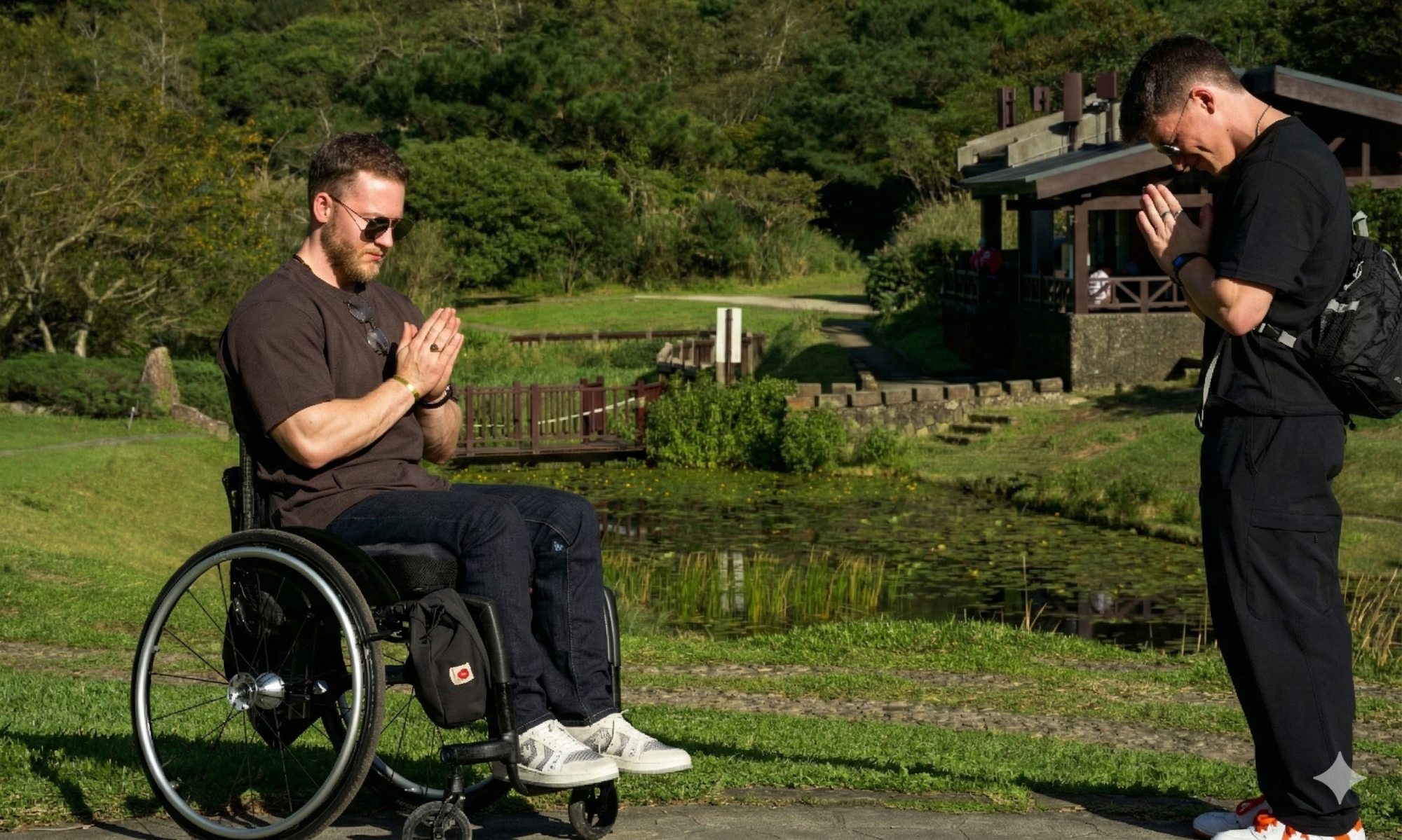






 Wheelchair DNA